Dinner is already behind schedule, the oven says 350°F, and the casserole is still cold in the middle. That is the point when most people start wondering whether the oven is actually broken, whether it is safe to use, and whether a repair will make financial sense. Knowing how to assess oven failure starts with separating a true heating problem from a setting, power, or door issue.
You do not need to take an oven apart to get useful answers. A few safe observations can help you explain the symptom clearly, avoid using an unsafe appliance, and make a faster repair decision.
How to Assess Oven Failure Safely
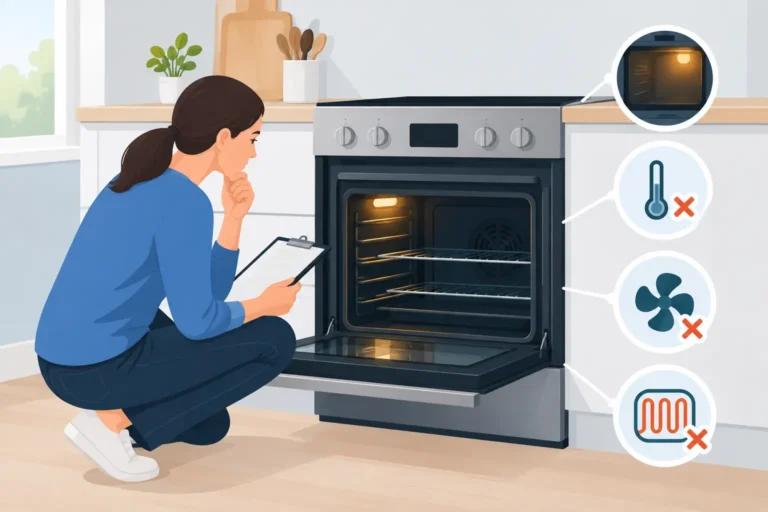
Start by identifying what the oven does, not what you think has failed. Does the display turn on but the oven stay cold? Does it heat, then burn food? Does the broiler work while bake does not? Those details point to different parts.
Before assuming the appliance needs repair, confirm that it is set to the intended cooking mode and temperature. On a range with a digital control panel, cancel the cycle, choose Bake again, and allow adequate preheat time. Many ovens signal that they are preheated when the air near the sensor reaches temperature, while heavy cookware and the oven walls may still need a few more minutes to stabilize.
If the display is blank, check whether the appliance has power. A household oven can be on a 240-volt circuit, and an electric range may appear partly functional when one side of its breaker has tripped. Check the breaker panel once and reset a clearly tripped breaker once. If it trips again, leave it off and arrange service. Repeated breaker trips can indicate a shorted heating element, wiring problem, or another electrical fault that should not be chased with repeated resets.
For a gas oven, look for a normal, even ignition through the oven window if your model has one. You should not smell unburned gas after the ignition sequence has had time to complete. If you smell gas, turn off the oven if it is safe to do so, leave the home, and call 911 or your gas utility from outside. Do not use switches, lighters, or other ignition sources in the area.
Match the Symptom to the Likely Problem
An oven that will not heat at all is not always the same repair as an oven that heats poorly. The most common failed parts depend on whether the unit is gas or electric and which cooking functions still work.
The oven is cold, but the display works
On an electric oven, a failed bake element is a common cause. The bake element is the lower heating loop inside the oven cavity. It may have a visible blister, crack, or burned spot, though some failed elements look normal. A faulty temperature sensor, electronic control board, or failed relay can cause the same symptom.
A useful clue is whether Broil still works. If broil heats but bake does not, the bake element or its control circuit becomes more likely. If neither function heats, diagnosis needs to look more closely at the power supply and control system.
On a gas oven, the likely failures often include the hot-surface igniter, gas safety valve, or control board. A weak igniter can glow yet still fail to draw enough electrical current to open the gas valve. That is why a glowing igniter does not automatically mean it is good.
The oven heats, but the temperature is wrong
If food is consistently underdone or overdone, first test the pattern over two or three normal cooking cycles. An inexpensive standalone oven thermometer can be useful for comparison, but do not treat one reading as a final diagnosis. Oven temperatures naturally cycle above and below the set point, and thermometer placement changes the reading.
A temperature sensor that has drifted out of range, a weak element, poor door seal, or a control problem can all create inaccurate temperatures. The manufacturer manuals for many GE and Frigidaire models describe error messages related to temperature sensing and overheating. For example, GE manuals commonly associate F2 with an over-temperature condition and F3 with a sensor circuit issue, while Frigidaire manuals commonly use F10 for a runaway temperature condition. Codes vary by model, so record the exact code rather than relying on a generic chart.
If the oven runs far hotter than selected, keeps heating after being turned off, or shows an overheating code, stop using it. A stuck relay or failed control can allow continued heating and needs prompt professional attention.
The oven door will not close or lock
A damaged or flattened door gasket lets heat escape, extends cook times, and makes cabinets and handles hotter than normal. Check for food debris along the gasket and door frame, and clean it with a damp cloth once the oven is cool. Do not pull hard on the gasket or use sharp tools around it.
If the door is locked after a self-cleaning cycle, do not force it. The lock mechanism may be waiting for the cavity to cool, or its switch may have failed. Self-clean cycles expose electronic controls and door-lock parts to very high heat, which is one reason oven problems sometimes appear immediately afterward.
What Is Urgent and What Can Wait?
An oven that simply takes too long to preheat is frustrating, but it is usually less urgent than an oven with an electrical burning smell, sparking, smoke, a gas odor, or uncontrolled heat. Stop using the appliance for any of those conditions.
Also take a failed range seriously if it shares a circuit with other kitchen equipment and repeatedly trips the breaker. Do not continue baking by resetting the breaker each time. The U.S. Consumer Product Safety Commission advises consumers to stop using appliances that show signs of electrical failure, including smoke, sparks, or unusual odors.
For San Diego households, heat can make a marginal oven more noticeable. During a warm spell, a kitchen already carrying heat from cooking, sun exposure, and air conditioning demand can make long preheat times feel worse. Coastal humidity and salt air can also contribute to corrosion over many years, particularly on exposed connections and control components in communities near the coast. That does not prove corrosion is the cause, but it is worth mentioning during diagnosis.
What a Repair May Cost and Whether It Makes Sense
A technician should diagnose the failed part before quoting a repair. Oven symptoms overlap, and replacing parts based on a guess can cost more than a proper service call.
In the San Diego area, typical installed repair ranges often fall around $175 to $350 for a temperature sensor or door-switch-related repair, $180 to $400 for an electric bake or broil element, and $200 to $450 for many gas igniter repairs. An electronic control board can run roughly $300 to $700 or more, especially for premium brands or models where the part is difficult to source. The final price depends on the model, part availability, and whether more than one component has failed.
Age matters, but it is not the only factor. The National Association of Home Builders’ life-expectancy study lists an expected service life of about 13 years for electric ranges and 15 years for gas ranges. A five-year-old oven with a failed igniter or element is usually a straightforward repair candidate. A 14-year-old unit needing an expensive control board deserves a repair-versus-replace conversation, particularly if parts are discontinued or other functions are also failing.
Built-in wall ovens and premium ranges are different. Replacement can involve cabinet changes, matching trim, delivery access, and installation costs, so a repair that looks high compared with a basic freestanding range may still be the practical choice. For renters and property managers, documenting the exact symptoms, error code, and whether the appliance is unsafe helps speed up approval and scheduling.
What to Have Ready for a Service Visit
Take a photo of the model number tag, usually found around the door frame, drawer area, or side of the oven opening. Note the exact error code, which modes work, when the issue started, and whether it followed a power outage or self-clean cycle. If you have noticed a burning smell, gas smell, breaker trip, or visible damage, say so when scheduling.
That information lets a technician arrive prepared for the most likely repair. At Alfa Appliances, the diagnostic service call is $65 and is waived when you approve the repair; all repairs include a 90-day labor warranty.
If your oven is overheating, sparking, smelling of gas, or repeatedly tripping a breaker, leave it off and get help rather than testing it again. For a clear diagnosis and honest repair recommendation in San Diego County, call (619) 458-6508 or book online 24/7 – same-day appointments are often available.